
The flaw’s the limit
Strength and toughness are different things – nature prefers the latter

Great Papers–Hidden Ideas Reshaping Reality. Strength and toughness are different things – nature prefers the latter
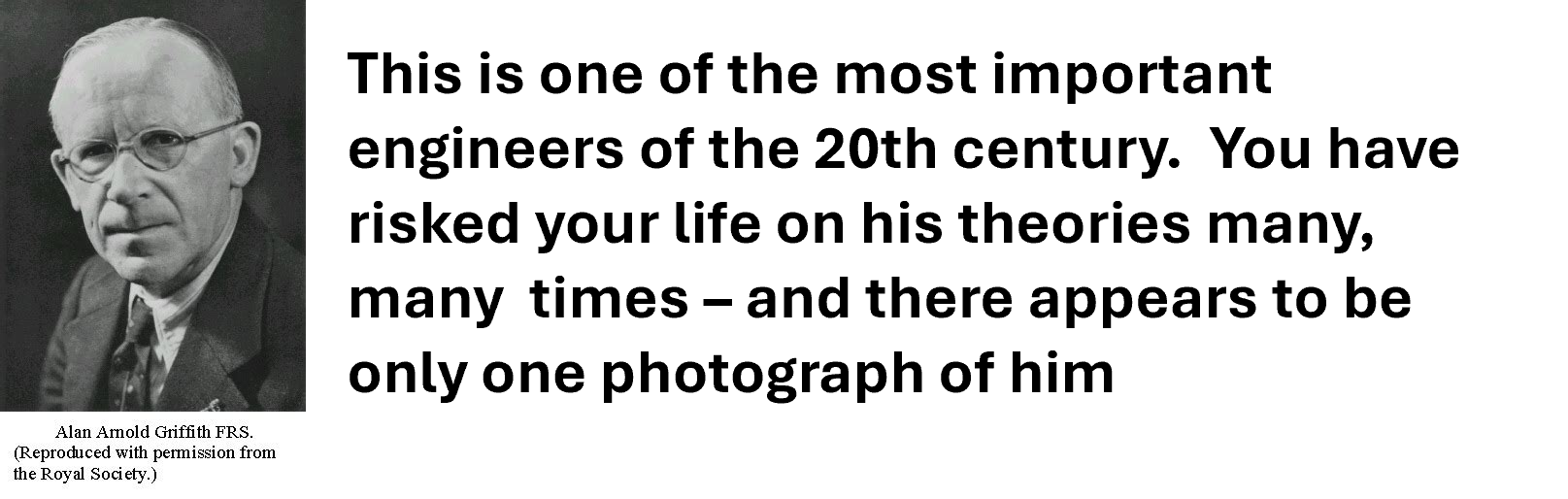
When you next glance outside at the flexing wing of your plane, it’s likely that other passengers are also pondering the skill of its design engineer. They must surely understand the strength of the materials they use and the bendy structures they create mustn’t they? But for much of industrial history this confidence rested on a puzzle bordering on embarrassment: materials consistently broke at stresses far below, sometimes just one thousandth, of the expected value,
Brittle materials like glass and cast iron were among the most obvious humiliations. Their atomic bonds are strong. A piece of glass should resist enormous tension. In practice it doesn’t. Nineteenth-century engineers responded as engineers often do: by adding thicker margins of safety and hoping for the best. That wasn’t going to work so well for aircraft and that is why, in the early years, cloth and wood whose strength comes from natural fibres, remained the preferred aeronautical materials. They still perform rather well.
The underlying problem was that materials are not governed by averages. They are governed by exceptions. It’s a profound, almost philosophical, thought.
In 1921, a 28 year-old engineer, Alan Griffith, published The Phenomena of Rupture and Flow in Solids. It became the foundation of the new science called ‘fracture mechanics’. Griffith’s central insight seems almost trivial: tiny flaws matter far more than the bulk material surrounding them. The truly shocking part was how much more.
Griffith had been studying glass fibres, partly because they could be manufactured unusually close to perfection. The more carefully handled fibres were usually stronger. This was awkward. Strength, according to the existing understanding, should depend primarily on the material itself, not on whether someone had breathed on it while carrying it across the laboratory.
Griffith realised that microscopic cracks concentrate stress with astonishing efficiency. A material under tension does not distribute force evenly near a crack. Instead the forces concentrate around the crack tip, amplifying the local stress far beyond the average applied load. A tiny defect becomes a weapon aimed inward at the material itself.
But Griffith’s truly important insight was even deeper. He showed how fracture could be treated as an energy problem.
Cracks do not propagate without reason. Creating new surfaces requires energy. But stretching a material also stores energy, rather like stretching a spring. Griffith showed that, once the stored energy exceeds the energy needed to create new surfaces, fracture becomes energetically favourable. Suddenly the material wants to relieve its stress, particularly around the flaw, by creating new surfaces, and the crack runs catastrophically through the material and the object fails, often at terrifying speed. This applies to all kinds of materials and not just hard brittle ones. A balloon popping is a perfect example of that.
Griffith’s theory also explained something previously mysterious: why larger structures are often weaker than smaller ones. Bigger objects simply contain more opportunities for dangerous flaws.
During the Second World War several Liberty ships cracked suddenly and catastrophically in cold Atlantic waters. Some broke almost clean in half. The ships were welded rather than riveted, efficient to manufacture but less tolerant of crack propagation. Tiny flaws, residual stresses and cold Atlantic temperatures combined into a deadly lesson in fracture mechanics.

Earlier industrial thinking implicitly assumed that strength was a bulk property: enough steel meant enough safety. Griffith’s work suggested otherwise. Failure originates locally, often invisibly, and tiny imperfections can dominate the behaviour of enormous systems. It became essential not to consider just the strength of the material, how much stress will tear it apart, but also its toughness, how resistant is it to cracking which is a function of it surface energy. This last property can sometimes be estimated not with enormous testing machines but by seeing how a drop of water spreads out, or stands proud, on a surface.

With these insights Griffith created a whole new 20th century science, incorporating fracture mechanics and metal fatigue. And this was only part of his overall contribution which also included important theoretical underpinning for jet engines.
Nature of course has evolved to do things differently. Its structural materials, like bone, wood and shell are not strong materials in the simple sense. But they are tough, often by being fibrous or layered. Cracks are deflected, blunted or trapped before they can spread catastrophically. Biological materials often sacrifice absolute strength in exchange for resistance to failure. A tree branch bends, fibres peel apart and energy dissipates gradually. Glass, by contrast, stores elastic energy beautifully right up until the moment it explodes. Nature strongly prefers toughness.
Modern engineering increasingly copies this biological caution. Composite materials, laminated safety glass and fibre-reinforced structures all sacrifice some idealised perfection in exchange for damage tolerance. Engineers learned, slowly and expensively, that preventing every crack is impossible. Managing cracks is achievable.
There is also a wider intellectual lesson hidden inside Griffith’s paper. We instinctively think in averages. Economists discuss average growth, politicians average incomes, managers average productivity. But complex systems are often controlled by rare defects, local concentrations and improbable events. A tiny crack can destroy a ship. A single software vulnerability can compromise a continent-wide network. A microscopic mutation can reshape an ecosystem.
The flaw is often vastly more important than the average condition surrounding it.
________________________________________
Griffith, A. A. (1921). The Phenomena of Rupture and Flow in Solids. Philosophical Transactions of the Royal Society A, 221, 163–198.
Excellent!! Where it gets really interesting for me is when you apply it to organisations, leadership, culture and people - my world.
Most organisations measure averages.
Average engagement.
Average performance.
Average customer satisfaction.
Average sales.
But organisations don’t usually break because the average is bad.
They break because there’s a crack.
One toxic manager.
One team that doesn’t trust leadership.
One product nobody is paying attention to.
One assumption nobody has challenged.
The crack grows quietly until suddenly everyone says:
“Nobody saw this coming.”
Congratulations, Nigel. This is a superb article. Griffith’s insight seems obvious once explained, yet it completely changes how we think about materials, engineering and even complex systems in general. What I particularly enjoyed is how it reminds us to question things we take for granted. We assume strength is everything, when in reality toughness and the management of imperfections are often what determine survival. Engineers such as Griffith, and before him pioneers like Gustave Eiffel, helped transform observations into theory and theory into practical engineering. Today many of these concepts seem self-evident, but only because remarkable people did the hard work of discovering and formalising them.
Thank you for bringing Griffith’s work back into the spotlight. It was both educational and thought-provoking.